Wednesday, November 3, 2010

Sightings...


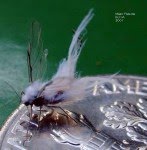
Often I'll get a call about a pest problem and I know if one person is seeing this problem, others probably are too. Today's sighting....Woolly Alder Aphid! If you are seeing fluffy white masses on your silver maples or alder trees, it's probably this critter. From what I've read on the web, some people actually enjoy their almost fairy like appearance. They look like a bug wrapped in an ostrich-feather boa. For the most part, they shouldn't require chemical or other type of intervention, though they may cause a mess with the honeydew they excrete. For more detailed information, follow the link to the NCSU insect notes:

http://www.ces.ncsu.edu/depts/ent/notes/O&T/trees/note06/note06.html

Thursday, October 21, 2010

The New York Times...for the latest on farming?

Seems like every time I turn around there's an article on farming or associated topics in the NYT. Maybe I'm just now noticing, or is there actually an increase in these types of articles due to rising awareness and interest in the readership on this topic?
Here' an interesting one on a seed saving library in New York.

http://www.nytimes.com/2010/10/07/garden/07seed.html?_r=1&hpw

Monday, October 11, 2010

Sweetpotatoes: not just for Thanksgiving anymore


Check out the news from Center for Science in the Public Interest: the sweetpotato (please note: technically, it is one word, not two) is the healthiest food in the top 10 Best Foods category! And of course, North Carolina is #1 in the Nation in sweetpotato production. So, support your local farmers and support your health by eating more of this super vegetable!

Ten Worst and Best Foods

Ten Worst and Best Foods

Friday, September 24, 2010

Stink bugs on the rampage


From: Mike Waldvogel, Extension Entomology

We are getting a lot of reports of houses being inundated with what
is likely the brown mamorated stink bug. This insect is a pest of a
wide variety of agricultural and horticultural crops including soybeans,
fruits, and ornamentals. When it's done feasting on these crops,
the adults turn their attention to finding a place to overwinter. This
situation is virtually identical to the problems with have with the Asian
lady beetles except they actually stink worse than the lady beetles do
when you crush them (they are called STINK bugs for a reason!)
The problem is also identical to the beetle in that little can be done
to stop them. Pesticide applications to the exterior of houses make
kill bunches of them IF you spray them directly or if they land on
treated surfaces in a day or so but for the most part that victory of
the bugs is short-lived and they may be back. So, people can spray
what they want outdoors just if it keeps them amused but don't expect
it to have any real impact. I would discourage spraying indoors because
there is no specific target site and excessive indoor applications are
potentially harmful to the occupants. If they want to spray around
windows and doors, do so OUTSIDE. Use a vacuum cleaner to collect
them indoors.

This problem is relatively new for us but has been occurring north of
our border for some time. One of the better summaries can be found
at Penn State's website:

http://ento.psu.edu/extension/factsheets/brown-marmorated-stink-bug
Wednesday, June 30, 2010

Scale insect workshop


Area landscapers from Moore, Richmond, and nearby counties had the opportunity to get up close and personal with a selection of scale insects at a recent pesticide training at the Sandhills Research Station in Montgomery County. NCSU Entomologists led a program on the biology and control of scale insects, which can be important pests on ornamentals and fruit trees. Managing scale can be a challenge for landscapers, especially as knowledge of the insects lifecycle is important to successful control. Each participant received a small bag with several different species of scale insects, for a hands on identification experience.

Wednesday, February 10, 2010

Eliot Coleman: organic pioneer

"Thomas Jefferson said he didn’t think we could have democracy unless at least 20% of the population was self-supporting on small farms so they were independent enough to be able to tell an oppressive government to stuff it."

Read more: http://www.grist.org/article/small-is-beautiful-and-radical

Friday, January 8, 2010

Community Supported Agriculture Informational Meeting


A meeting on developing a Community Supported Agriculture (CSA) farm was held at the Moore County Cooperative Extension Office on Tuesday, January 5. A CSA farm is a farm operation where a farmer (or group of farmers) delivers a weekly box of produce to members of a subscriber group. There are currently over 80 CSAs in North Carolina, a rapid increase in numbers in recent years, as interest on the part of consumers grows. The gathering on Tuesday exceeded expectations, with more than 60 people attending from several surrounding counties, including Moore, Richmond, Randolph, Robeson and Hoke. Presenters included Jon Parsons, Director of Sustainable Sandhills, Judy Lesslor, a Chatham County farmer with a CSA, and horticulture agents Taylor Williams and Paige Burns. Jon Parsons presented data from a survey conducted by Sustainable Sandhills which sought information on the level of interest of SS members in participating in a CSA. With over 600 responses, nearly all expressed an interest in participating in or learning more about a CSA. However, there are no CSAs currently in the Sandhills region, which opens up exciting opportunities for local growers if they can learn how to successfully operate a CSA.

Other speakers worked to provide information on just that. Judy Lesslor, who farms organically and has had a CSA for 8 years at her historical Harland's Creek Farm near Pittsboro, shared valuable insights and tips that have been keys to her own success. Taylor Williams, horticulture agent for Moore County, gave detailed information on scheduling, planting, and harvesting produce for weekly delivery. Paige Burns, horticulture agent for Richmond County, discussed how to reach new customers, as well as keeping existing customers engaged, with a diversity of on line marketing sites and formats. Finally, Jan Leitschuh, with the up-and-coming Sandhills Farm 2 Table Cooperative, discussed the new operation and how it could serve farmers who weren't quite ready to take on their own CSAs just yet.

It was an exciting afternoon for all, attendees and presenters alike, because of the opportunities and benefits CSAs offers both farmer and consumer. All attendees took home a packet of information, including a CD with a planting planning program (say that 5 times quickly) designed specifically for CSAs. Hopefully, this workshop will help bring even more locally grown food to the Sandhills soon!

Tuesday, December 22, 2009

The Lunch Box is a great new website I stumbled across, with the goal to improve school lunches, making for healthier, smarter kids. This is such an important issue, especially when you consider the statistics that show that the current generation of teenagers are predicted to be the first generation with a shorter lifespan than their parents, and the prediction that 1 in 3 white and 2 in 3 minority children will be diagnosed with Type 2 Diabetes by the time they graduate from high school!

http://www.thelunchbox.org/http:/

Monday, December 14, 2009

If you are interested in reptiles and amphibians, check out this link to the Carolina Herp Atlas:

Since March 2007, the CHA has collected over 15,000 reptile and amphibian observations in the Carolinas. Please submit your reptile and amphibian observations to the Carolina Herp Atlas at www.carolinaherpatlas.org. Contact Steven Price at sjprice@davidson.edu with any questions you might have.
From Steven Price, the Dept. of Biology at Davidson, at way people can help scientists keep track of reptile and amphibian populations:
"Have you ever seen an eastern kingsnake in your backyard or found a Fowler’s toad on your porch and wondered if wildlife biologists needed to know about it? These observations are important and now there is a place to submit your observations that can help with the conservation of amphibians and reptiles in the Carolinas: The Carolina Herp Atlas (CHA). The CHA, developed by the Davidson College Herpetology Laboratory and Davidson College Information Technology Services, is an online database that uses observations by citizen scientists to track reptile and amphibian distributions in North and South Carolina. Funded by the North Carolina Wildlife Resources Commission and South Carolina Department of Natural Resources, the CHA also allows users a simple way to maintain a personal database of the reptiles and amphibians they observe. County-level distribution maps can be viewed by anyone who visits the website. Wildlife biologists and herpetologists can use these data to understand activity periods, habitat relationships, distribution, conservation status and other facets of amphibian and reptile ecology in North Carolina.
How does the CHA work? Before you can submit records, you must first register and set-up a “My Herps” account. Once you register, you are able to add records and keep track of your observations. Each observation should include: 1) state and county, 2) genus and species, 3) date, 4) location, 5) geographic coordinates (using our GeoLocator) 6) remarks, 7) and a digital photo for verification of the species identification. The GeoLocator allows the user to pinpoint the exact location of their herp observation.
Since March 2007, the CHA has collected over 15,000 reptile and amphibian observations in the Carolinas. Please submit your reptile and amphibian observations to the Carolina Herp Atlas at www.carolinaherpatlas.org. Contact Steven Price at sjprice@davidson.edu with any questions you might have."

Tuesday, February 3, 2009

Fruit tree grafting

I have a wonderful old pear tree in my yard. I have no idea how old it is, but half of the tree trunk is rotted away, and anyone looking at it would wonder how it could still be alive. Two years ago, our first summer in the house, it boasted a huge number of large round, green, crisp and juicy pears. They were delicious! Last year it produced nothing, but I have hope for this coming year. Anyway, my fear is that one day an ice storm (or a slight breeze) will come along and the old dear will split in two. In the hopes of keeping this glorious, if unknown, variety of pear going, I just took cuttings to provide scions for grafting. A farm up in Reidsville, Century Farm Orchards (www.centuryfarmorchards.com), grows heirloom varieties of apples and pears, ones grown for hundreds of years in the South, and adapted to our climate. They will also graft trees if people have old varieties at home they want to perpetuate. Fruit trees are typically grafted: this means that the top portion of the tree is one variety, and the bottom (roots) is a different variety, one which is more hardy than the top. Rootstock may also lend size characteristics to the tree, with semi- dwarf and dwarf rootstocks available which limit the height of the tree. They'll take my cuttings, graft (attach) to a hardy rootstock, and look after the new creations throughout the summer. Then, in the fall, the proper time to plant fruit trees, I'll ride up to CFO and pick up my new baby pear trees! I'll plant the pears near the 4 heirloom apple varieties I got at CFO last fall.

I'm already looking forward to having some of their sublime homemade apple cider.

Thursday, December 11, 2008

Millipedes

Several times a year I get calls from distressed homeowners concerned with the invasion of their garages, crawl spaces, and even their living rooms with masses of small, worm-like creatures with legs. These are millipedes. These critters may be annoying, but there is no reason to be alarmed. Ordinarily, millipedes live in organic matter such as under piles of leaves or pinestraw, or in lawns with thatch. Dry, hot weather, wet weather that causes soils to become saturated, or fall migrations to overwintering sites will sometimes cause the household invasions that generates the phone call to my office. Usually the caller is looking for a brand of insecticide to spray to kill the little buggers. However, the first response should be to remove millipede habit from near the home, such as piles of leaves or other debris. Correct drainage problems that create dampness near walls, and improve ventilation in crawl spaces. A vacuum cleaner is also a handy way to get rid of millipedes if they get really numerous in your home. Once the environmental conditions that instigated the migration change, your uninvited guests will probably return to their own homes and leave you in peace. For more information, click the link to the NCSU information sheet on millipedes: http://www.ces.ncsu.edu/depts/ent/notes/Urban/millipedes.htm

Tuesday, December 9, 2008

local food

Yesterday I attended a regional meeting on developing local food systems. Attendees were from a diverse community, including Extension people, farmers, people from faith communitees, nutritionists and people in public health, and more. What brought us all together was a passion for developing access to fresh, local, healthy food grown and produced by our neighbors. This meeting was one of six which are taking place across the state. There are many hurdles to overcome as we work toward making locally grown food more available to consumers. However, there is a reason that the Oxford Dictionary "word of the year" for 2007 was "Locavore"...more and more people are realizing the value of purchasing fresh, nutritious food directly from their neighbor or fellow North Carolinian, as opposed to buying from a faceless individual or corporation hundreds or even thousands of miles away.

Some interesting facts associated with local food production:
  • North Carolina is the 8th largest agricultural state in the nation
  • North Carolina is one of the most diverse agricultural states, growing everything from apples to zucchini
  • Agriculture is the largest industry in the state, with 20% of the labor force working in agriculture or agribusiness.
  • North Carolina is tied for first place in the nation for loss of farm land to development
  • If every person in the state spent a mere 0.55 cents on locally grown food, it would create 1.7 billion in revenue.
  • Money spent on locally produced food stays within the state and has a "mulitplier effect", as it continues to circulate within the state without leaving North Carolina.
  • A strong local food system reduces reliance on fossil fuels: studies have shown that food on average travels 1500 miles before reaching the consumer.
  • Just as we are striving for energy independance, we should strive for food security through a strong local food system. We do not want to be dependant on foreign countries for the ability to feed ourselves.

These are just a few of the reasons developing a local food system is important to North Carolinians.

As this endeavor develops and progresses, I will continue to provide updates. In the meantime: be vocal at your local grocery store and restaurant about your interest in locally produced fruit and vegetables. Business responds to the desires of the consumer, so share your feelings with the businesses you support and encourage the same in friends and neighbors!

Wednesday, December 3, 2008

The Ginkgo tree

I love ginkgo trees in the fall, especially mature trees such as this one. Wikipedia has good info on this prehistoric tree (http://en.wikipedia.org/wiki/Ginkgo_biloba); perhaps not everyone is aware of it's status as "a living fossil". The trees have the appealing habit of dropping all of their leaves at once in the fall, so you only have to rake them up one time. Their primary drawback: the fruit smells rotten or, more accurately, like feces, when they ripen and fall to the ground. Though only male trees should be planted, occasionally you will find a female tree in the landscape. At a recent farmer's market excursion, I finally determined what I thought was a "dog walk area" was really the location of a female ginkgo tree! The fruit look very similar to the native persimmon, and I cautioned several people from picking the fruit off the ground, apparently their noses lagging somewhat behind what their brains were telling them to do.